Schontje Becht-Beugeltas
The only one with a grave
Posted by Dennis Koopman on 29 January 2023
Schoontje was my grandmother's older sister. Together with her husband Philip and her youngest brother Joop (Joseph), they were so cornered by the Nazis in early 1943 that they saw no other way out than to leave everything behind and seek refuge in neutral Switzerland.
At the end of January/beginning of February 1943, Schoontje, Philip, and Joop crossed the Belgian border into France. This route to Switzerland was already considered quite hopeless at the time, but as a non-Jew, Philipp probably thought he could offer his wife and brother-in-law sufficient protection and perhaps hoped that Switzerland would open its doors to them.
Philip's younger brother was in the resistance and helped search for and guide people to hiding places. This may have seemed like a safe option for Schoontje, Philip, and Joop, but escape must have seemed like a better chance of survival. Another brother was entrusted with managing the funds, and it was agreed that money would be transferred at regular intervals after contact to cover the costs of the stay abroad. When the money didn't arrive, it emerged that the brother had absconded with the money and collaborated with the occupier. After the war, he was arrested and convicted for betraying a group of men who were trying to avoid the forced labor camps by going into hiding.
Philip, Schoontje, and Joop were arrested at the Swiss border in March 1943 and taken to the Besançon prison. There they were separated: Philipp was sent to Frontstalag 122 in Compiègne, a camp for political prisoners and resistance fighters, while Schoontje and Joop ended up in Drancy, the transit camp for Jews near Paris. Schoontje and Philip would never see each other again, but the hope of a speedy reunion must have kept the lovers alive for a long time.
That, and a fair amount of luck, because Schoontje was drafted into forced labor after her arrival at Auschwitz and ended up in the Birkenau camp. Unlike her brother, who, despite his young age, had no chance. Joop was a nurse, and the Nazis didn't need this profession. Joseph Beugeltas was murdered on June 27, 1943.
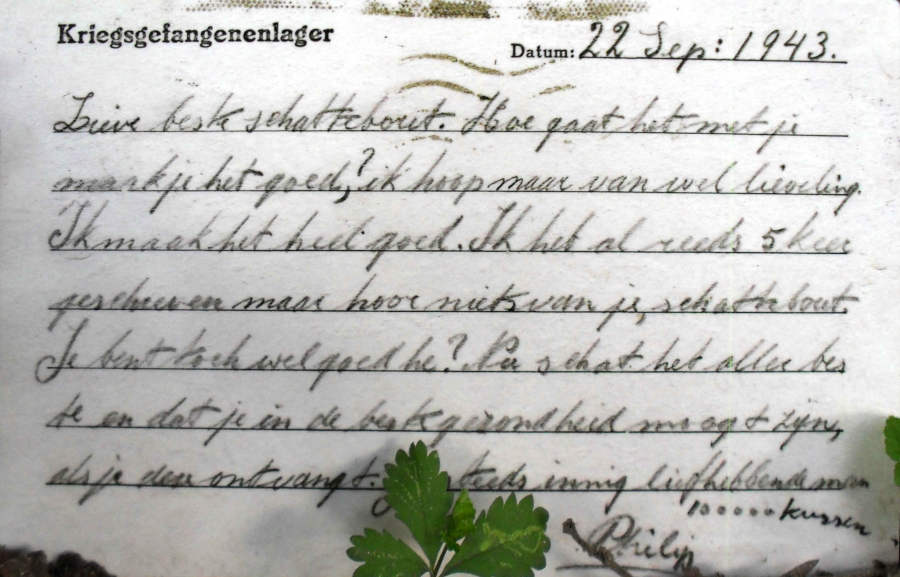 Philip was transported from France to Buchenwald in January 1944. A difficult time awaited him there. The work was physically demanding, and conditions in the camp were, of course, miserable. He fell ill until he received an experimental vaccination against typhus, among other diseases, and recovered sufficiently to participate in a death march in April 1945 along with 28,000 fellow prisoners. Philip Becht arrived exhausted in Theresienstadt, where he died on May 25, 1945. He was buried in a mass grave in the camp's Jewish cemetery. After liberation, two moving letters written by him to his wife were found in the files left behind at the Drancy camp.
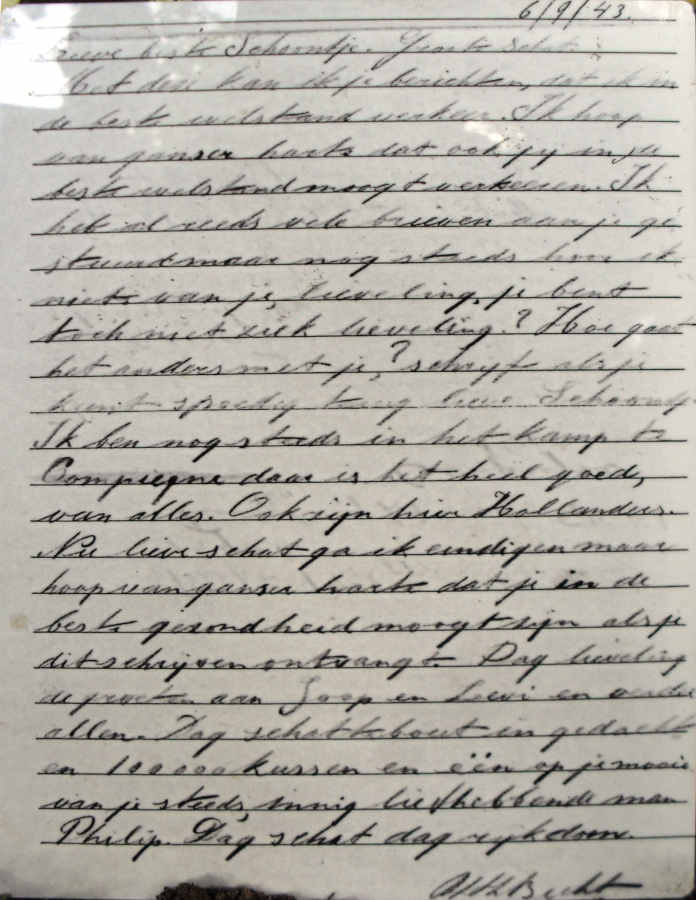 Schoontje never read the letters because she was already in Birkenau by then. She must have had a job there that gave her access to statistics, because when the camp was evacuated in January 1945, she was aged 45 years and was fit enough to survive the miserable death march to Bergen-Belsen. She was in such poor condition that in mid-February 1945, she was selected, along with 500 other prisoners, mostly girls and young women, for forced labor at the Venusberg camp, a subcamp of Flossenbürg, to assemble aircraft parts.
Venusberg was a fenced and heavily guarded women's camp on a factory site near Gelenau, with 1,000 Jewish forced laborers spread across five barracks. The camp administration was cruel, especially the female guards. There was a lack of everything: food, shelter, and medical care. This, combined with the harsh winter conditions, made work and life on Venusberg a living hell. Due in part to the outbreak of epidemics, the prisoners' health deteriorated rapidly, and women were dying every day. In April, this camp, too, had to be closed. The remaining women were crammed into closed train cars and sent south along the railway line, which had been bombed by the Allies. After an indescribable two-week journey with barely any food or drink, the train arrived at the Mauthausen concentration camp. Half of the 900 women died on the way there. The rest, including Schoontje, had to climb the steep stairs that provided access to the camp. There they were liberated by the Americans a few days later.
Schoontje was in poor condition and was lovingly cared by the staff of the 131st Evacuation Hospital at the Gusen satellite camp. Patients were gradually discharged or repatriated to their country of origin. The Dutch Red Cross never showed up, and Schoontje remained behind until the hospital had to be closed. A place was arranged for her among the French returnees who were not yet strong enough to go home. In Reichenau on Lake Constance, a former psychiatric hospital had been converted by the French occupying forces to serve as a military hospital. Schoontje arrived there on June 6, 1945. She gave the details of her sister, my grandmother, as her contact person. It was recorded phonetically by the French nurses, but the message never reached my grandmother, the sole survivor of the family back home in Amsterdam, who waited for news.
On June 20, one month after her beloved Philip died in the hospital, Schoontje Becht-Beugeltas passed away. Schoontje's name was also recorded phonetically, and so she ended up in the institution's cemetery under the fictitious name Schronte Becate. On her grave was a wooden memorial post bearing the Zionist symbol. A captain of the Identification and Recovery Service wrote in a report when he visited the cemetery in 1950 and discovered her grave. Only a few years later, the name Schronte Becate could be linked to Schoontje Becht, and in the run-up to her reburial in the place of honor in Frankfurt, my grandmother finally learned what had befallen her sister.
Schoontje was the only victim in the family who had a visiting grave. Therefore, she is unfortunately not mentioned on the memorial in Amsterdam, and we in the Netherlands cannot lay a stone for her. This is also why we have placed Stumble Stones for the entire family in Amsterdam.
Source: www.achterdesteen.nl
The text itself was taken from the website of the Oorlogsgravenstichting. |
Jurjen Terpstra
My father as a forced laborer in Germany
Posted by the daughter of Marti Terpstra.
Jurjen was born in Rotterdam into a left-wing family. His father came from a working-class background and was active in the trade union movement. Jurjen joined the State Postal Service (PTT) and worked as a mail carrier in Rotterdam. In 1939, he married the girl of his dreams, Cornelia Gijsberta van Krieken, and in 1940, their daughter Marti was born.
On May 10, 1940, German troops invaded the Netherlands. After the bombing of Rotterdam, the Dutch army surrendered, and the Netherlands was occupied by the Germans. After a brief period of disbelief and anger, normal life resumed. Jurjen returned to work as a mail carrier for the PTT. As part of the Arbeitseinsatz (Labour Deployment), Dutch men were forced to fill positions in Germany that became available because German men were required to serve in the German army.
In early 1943, Jurjen was forced into German labor. He ended up working for the post office in Frankfurt am Main. He stayed in a camp there, and life without his wife and child was difficult for him. He regularly received letters in which his wife, Cor, wrote about his daughter's development. In May 1943, Jurjen wrote: "You do start to long for home. Especially when you hear about that little cat, that she's becoming such a smart aleck." He was allowed to go home once for a short leave. There, he hugged his wife and daughter. However, this was short-lived. He had to return to Frankfurt.
Every free moment he made a drawing for Marti and sent it with a note to her in the Netherlands. Marti cherished these small signs of life from her father. In November 1944, this ended abruptly. It wasn't until December that Cor and Marti learned that their husband and father had died in a bombing raid on November 5, 1944.
Published by the Oorlogsgravenstichting Archives Coordinator on July 8, 2019 |
|